
Beginning and Ending with Emily: Ghazals and Golden Shovels

The Mystery of Belief
beginning with a Dickinson line (#1084)
At half past three, a single bird unto a silent sky.
The mystery begins with an airy clue, a silent sky.
Look down: avoid the washed-out sections of the trail.
Look up: an imagined rattle can imbue the silent sky.
Some see a mirage of God, some a God of mirage.
Close your eyes tightly–don’t misconstrue a silent sky.
Withdrawal is a familiar pattern; apology, another.
You try all day but cannot see through the silent sky.
By half past ten, the velvet canvas fills with stars,
the evening fragrant for a rendezvous, a silent sky.
Put your ears to your hands, your hands to the ground.
Believe what you feel, Scott, adieu this silent sky.
Nickole Brown, President of the Hellbender Gathering of Poets workshops and annual Festival asks: “What is it not just to read a poet’s work but to take them in so deeply that their being becomes a part of yours? Scott Wiggerman’s Beginning and Ending with Emily is, by far, the best example I’ve found of such a deep and abiding study, making together with Emily Dickinson a great quilt crafted in the sleepless hours of the night. As such, each of his poems backstitch into hers, taking the scraps of the heart to form a book wild but ordered, held fast by the constraint for which she is known but following the pull of a queer golden thread luminous and striking. The result is not just conversation but co-creation, an achievement of measure, candor, and above all, love—or, as he writes, ‘Emily’s now me, and I’m now her: so begins the soul.’”
Brian Turner, author of Here, Bullet and The Wild Delight of Wild Things, states: “Scott Wiggerman’s latest collection brings us the great sweep of questions which linger in our lives and in our bodies, questions which plumb the intimate and the spiritual, the mundane and the sublime. Here we are given the ‘secret thoughts I harbor deep within this inner room’ alongside moments of tenderness so fine the music lifts off the page, as it does when ‘[a] hummingbird quivers in the cup of their red hands.’ Gorgeous, nuanced, jeweled in the poet’s craft—the ghazals and golden shovels drafted by Wiggerman’s pen have ‘mouthed the words from memory’ as they ‘sing the scars of my naked self.’”
Hilda Raz, author of Letter from a Place I’ve Never Been: New and Collected Poems, says: “Poet and artist Scott Wiggerman is known for his attraction to and use of constraints, formal connections of one thing to another. He is brilliant and evasive, playful and deeply engaged and he teaches his fans – I am one of many — to appreciate and trust his work. His exquisite new book leans on two poetic forms, one old and the other from the 21st century, the golden shovel and the ghazal, both of which pay homage to others, and lines by another poet, Emily Dickinson, the 19th century progenitor of contemporary American poetry. Wiggerman weaves the language of many into his own ingenious and beautiful lines. And he uses the forms with aplomb and genius.”
Lauren Camp, New Mexico State Poet Laureate, 2022-2025, writes: “The book feels like a treasure hunt—plunging from Dickinson’s familiar lines into rhythms and questions edged by the chosen form. The poems are taut, personal investigations into new understandings of love. ‘You can outline a shore, but perilous to map the soul,’ the author writes—and yet this collection bravely does just that.”
Ed Madden, professor of English and Director of the women’s and gender studies program at the University of South Carolina, declares: “When Scott Wiggerman describes ‘the controlled permutations of go’ in “Calendar of Love,” it’s a window into the book. Control and urge, and the ways those drives inflect and transform each other. On the one hand, we have a calendar, the form through which we experience time; on the other, love, that malleable word that stretches the self and takes into its ambit the anxious escapades of youth, difficult relations with parents, a long-term commitment to a partner, and all the memories and aspirations that wrap and warp and weave those loves. There’s a wry self-awareness of his poetic constraints—as he says in “Self-Portrait as Emily,” ‘I always have a line’—but the energy of this book burns in how his words push and pull against and through hers.”
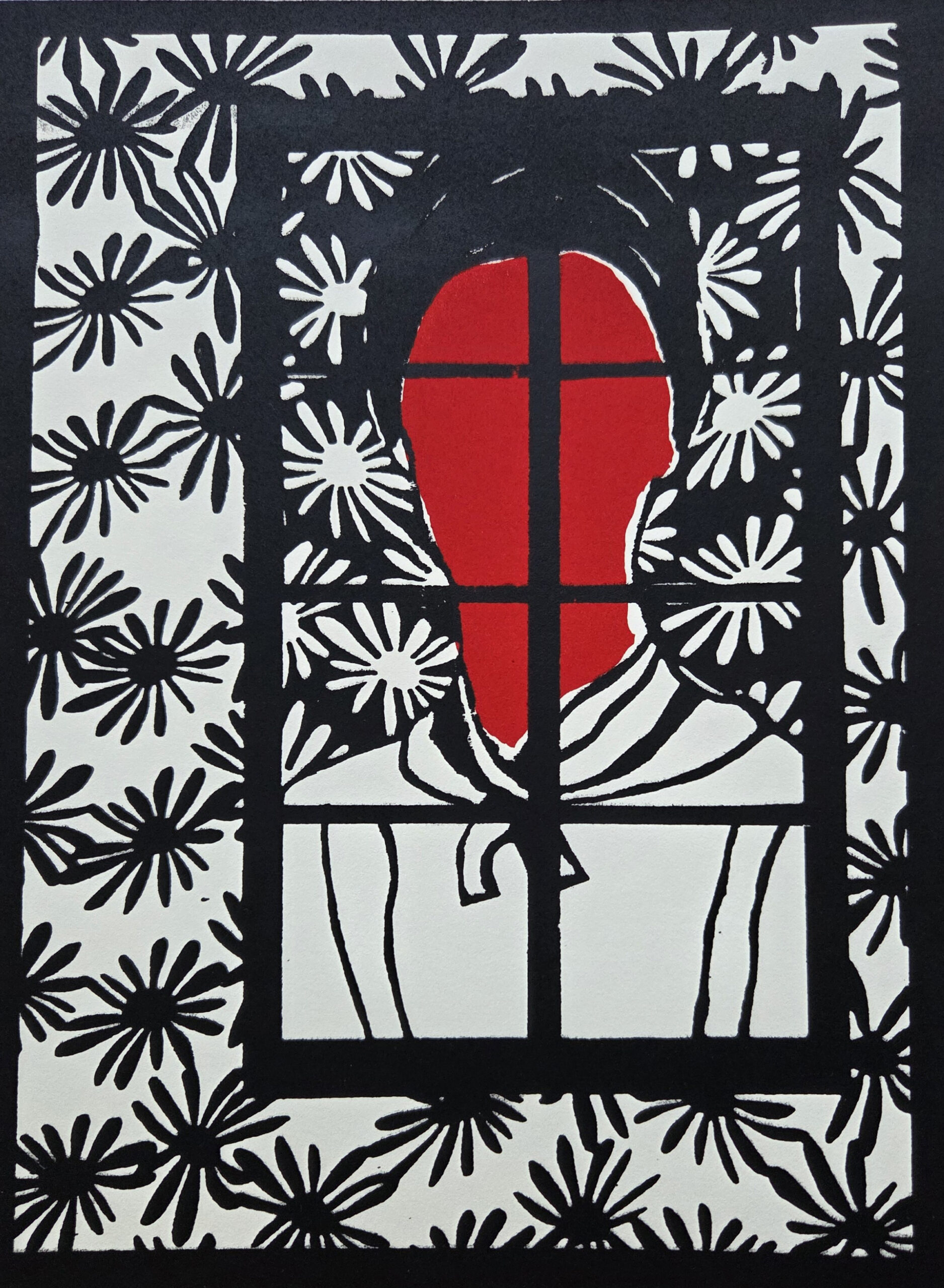
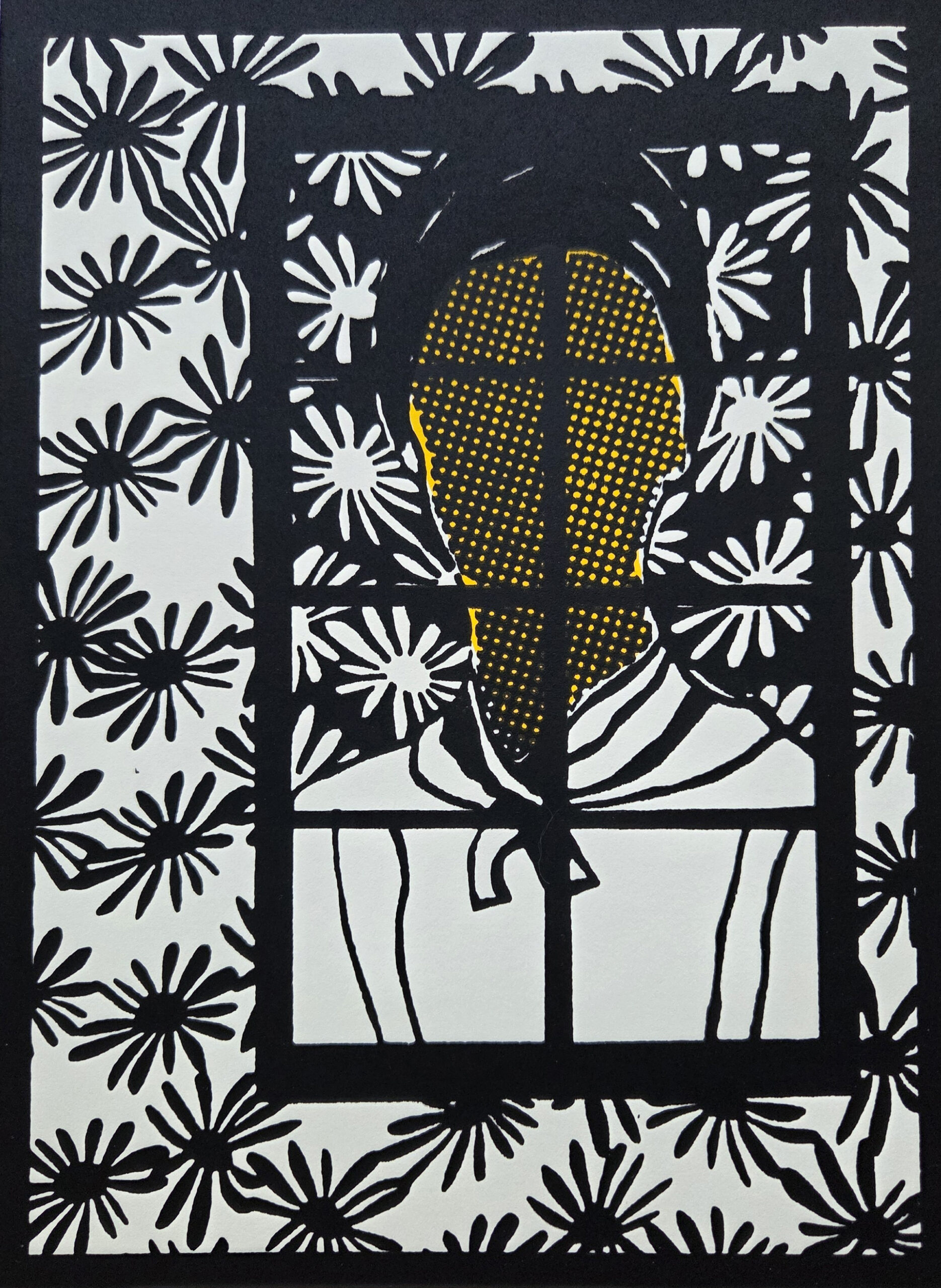

“Nobody (red),” “Nobody (yellow),” “Nobody (blue)” (2025 silkscreen prints)
Leaf and Beak: Sonnets

The Egret Sonnet
How radiant this egret, solid, right
as mountain ash—his preening at the falls
like a god. Lesser birds would take to flight
at my approach, but he stands bright and tall,
a mast unflinching. Water glides across
the ledge where he is anchored to the rocks,
a regal beacon rising out of moss,
his gaze as brazen as that ghostly shock
of white, accentuated by the sun.
Such elegance, this bird so long and lean
and singular, for in this dominion
no one can match his light, that glow, that mien.
He has earned my praise, for it’s neither pride
nor sin when reverence is justified.
Larry D. Thomas, author of As If Light Actually Matters: New & Selected Poems: “These sonnets are exquisite. They are as good as any I have read by contemporary American poets.”
Joanna Weston, author of Summer Father: “I’ve just finished Scott Wiggerman’s book, Leaf and Beak: Sonnets, which I absolutely love. He has a real gift for observing the minutiae of the world around him as he goes on his daily run round Mueller Lake. His ability with slant and half rhyme is phenomenal, so much so that the rhyme is almost unnoticed. I’m going to read it again, it’s such a joy.”
Justin Evans, author of Sailing This Nameless Ship: “I have for many years been a fan of Scott Wiggerman’s sonnets, and I would not hesitate to side him with the likes of Ernest Hilbert and Steven Nightingale as a master of this particular craft. I am even more fond of these sonnets because of their subject matter, which make me see the natural world in a whole new way each time I pick them up and read.”
David Meischen, author of Nopalito, Texas: ” The poems of Leaf and Beak are quiet poems, reflective poems, poems that ask you to walk in stillness for moments at a time, to absorb “the hidden in full view,” to appreciate “a lone green leaf / that hangs on like a weekend birthday, deaf / to bitter winds.” Wiggerman moves from the observed image, letting some details turn him inward while others lead to meditations on his fellow beings, on the world he walks. “What will / tomorrow bring that now cannot be seen?” he asks. “What change, what wonders to discover?”
Presence
Release
She hears gargled whispers,
not the ahs of an open throat:
something’s caught there.
She hears it again,
ka-ka-ka-ka,
a small bird lodged in her larynx:
cancer.
She curls in a nest,
not a womb,
but a briar of fear.
Hidden within the sinew,
among the muscle’s twigs and branches,
in the bone’s gray shadows,
a snake closes about her,
its thick black rope
twisting, severing.
She rasps for release,
for the ah, ah, ah of life,
but gurgles the word amen.
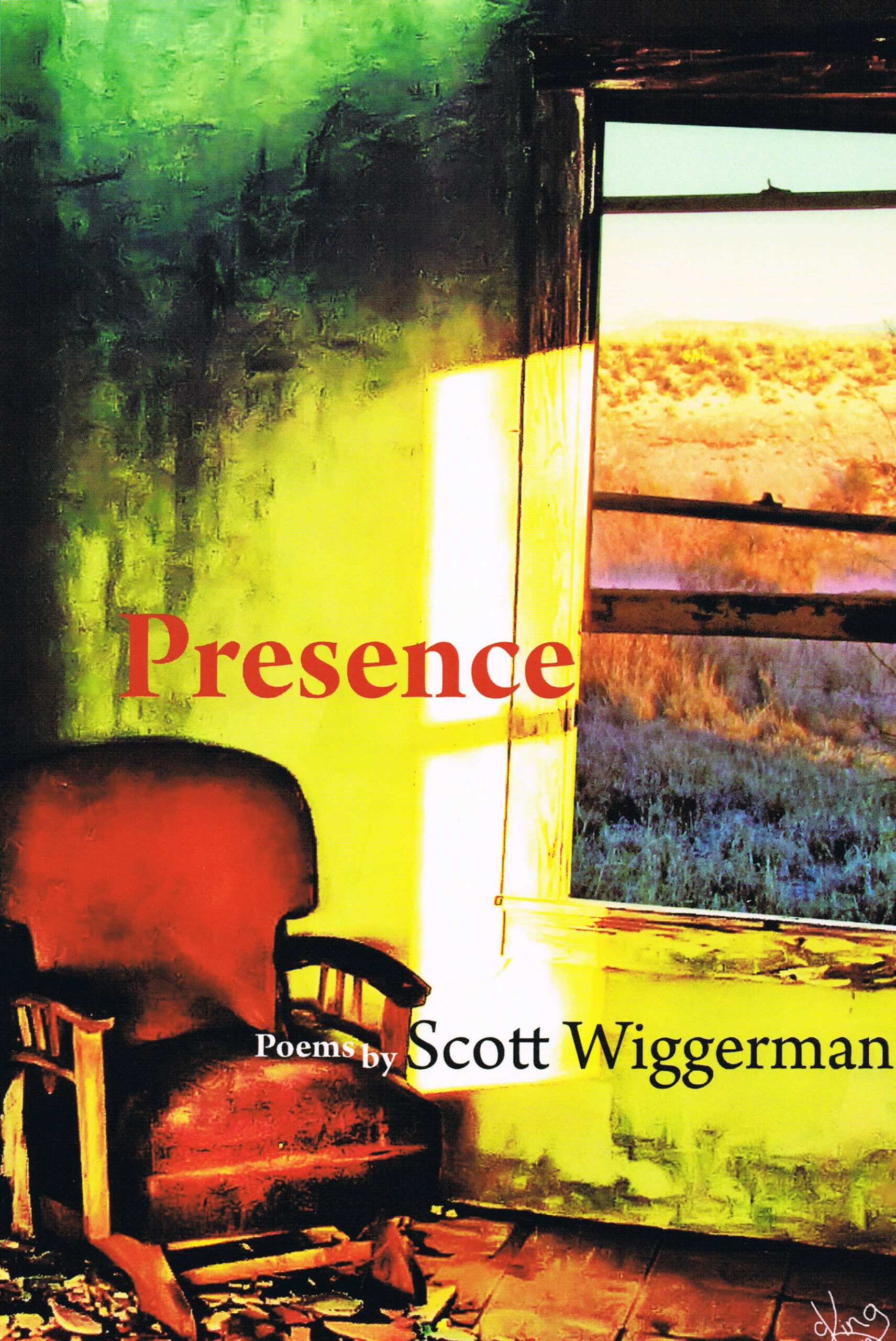
Cyrus Cassells, Lambda award-winning author of Beautiful Signor states, “In Presence, Scott Wiggerman uses an intransigent stain as an emblem of buoyant integrity in the face of intolerance and exclusion. In this new book, nimbly arranged by the elements, the poet, brandishing his trademark sass, humor, and candor, glories in local nature and limns the joys and trials of being a lovingly irreverent Texas gadfly, a proud and forthright gay man.”
Robert McDowell, author of the best-selling Poetry as Spiritual Practice, writes, “In Presence, we meet, in the poet’s own words, ‘the drumming of a buoyant heart.’ It is a sound that will not defer to injustice. It is an intelligent and artful yawp that won’t go quietly. It is a witnessing we need to hear in a world so full of babbling and duplicity. It’s the sound of truth itself . . . . Through it all, Wiggerman’s marvelous craft gives shape to his versatility and poignant insight. He is a must-read American poet. Share him with everyone you know who cares about words and the truth.”
Sarah Cortez, Texas Institute of Letters author of How to Undress a Cop, writes in Texas Books in Review, “One of the remarkable feats of this collection is the dual tasks the poet has accomplished: the precise communication of a fully realized life with its world of luminous revelations and the artful, effective claiming of so much inherently difficult territory—that of anger and that of eroticism, sometimes interwoven.”
Laurie Kutchins, Pulitzer-nominated author of The Night Path, says, “Presence evokes the elements–palpable qualities of air, earth, water and fire, and more–the difficult-to-render textures of familial love, lovers, loss, renewal, memory, and what one needs to stay present to the elemental world. So many moments in Wiggerman’s poems ‘evaporate like broth into essence,’ allowing us to feel absence become presence. And as the poet wisely notes, ‘the juxtaposition is seamless.”
Vegetables and Other Relationships
Bell Peppers
One by one
these cages have emptied,
my brothers taken away.
I’m the last one left
on this row of death.
All appeals have expired.
My walls are thick,
my membranes strong.
My stem’s grown tough
as I’ve served my time.
Yet tonight I’m sentenced
to lose what’s left
of what little is still mine.
Awake and alone
I gaze from my gloom,
murmuring laments
like a bell that has
lost its tongue.
My prayers are mute.
My God is gone.
I am not ready.
I am not guilty.
I have never been so hollow.
Judith Minty, author of Walking with the Bear, writes: “These well-wrought poems emerge from the physical garden of today and now. They are like the food of contemporary America in their wide range that satisfies the palate. From painful moments of childhood to silky erotica to delightful bursts of humor, Scott Wiggerman’s faith in the power of human love and caring prevails to make Vegetables and Other Relationships a true feast.”